
Rapid interconnection of new renewables is key to keeping electricity costs down. FERC Order 2023 aimed to accelerate interconnection by mandating RTOs shift from a serial, first-come, first-served study process to a first-ready, first-served cluster study process for transmission-connected projects. The Order also updated the requirements for when and how distribution-connected, state jurisdictional projects must undertake Affected System Operator (ASO) studies. Panelist Sarah Adams (ISO-NE), Lucas Looman (VELCO), and Thomas Hand (MHG Solar) discussed how the implementation of interconnection cluster studies has impacted timelines and costs for both FERC- and state-jurisdictional projects.
ISO-NE’s first cluster study, the Transitional Cluster Study (TCS), was completed on schedule in August 2026. Adams reported that the queue size shrank significantly after the transition to a cluster study approach, but the queue composition remained relatively stable, with wind, solar, and battery storage making up 99% of the queue both before and after the transition. Adams stated that this was consistent with the goals of the transition and represented a reduction in speculative interconnection applications. She emphasized that the cluster implementation was iterative and that the ISO was working to continue to improve the experience by creating a heat map showing estimated grid capacity and by engaging with customers to review and improve the process.
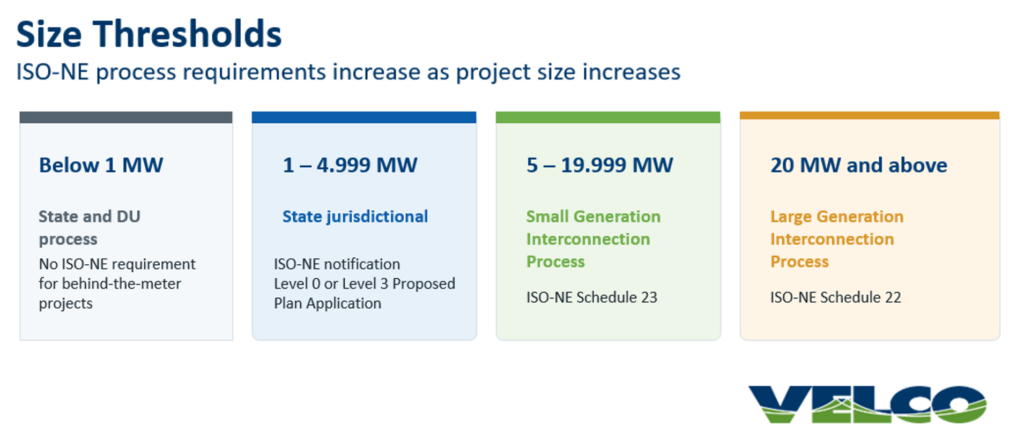
Looman focused on changes to the interconnection process for smaller, state-jurisdictional projects between 1 and 5 MW in size. These projects must be submitted to the ISO to determine if a Level III ASO study is required. Level III studies are triggered when the distributed generation in an “electrically close” area reaches 20 MW and add significant study time to the interconnection process. Fortunately, Looman highlighted that the process for this determination was updated at the beginning of October and the change would limit the number of Vermont distributed generation projects that would be subject to Level III study. Previously, the 20 MW threshold for Level III study included both existing and proposed projects, but under the updated procedure only proposed projects will count toward the threshold, greatly reducing the likelihood that the analysis will be required.
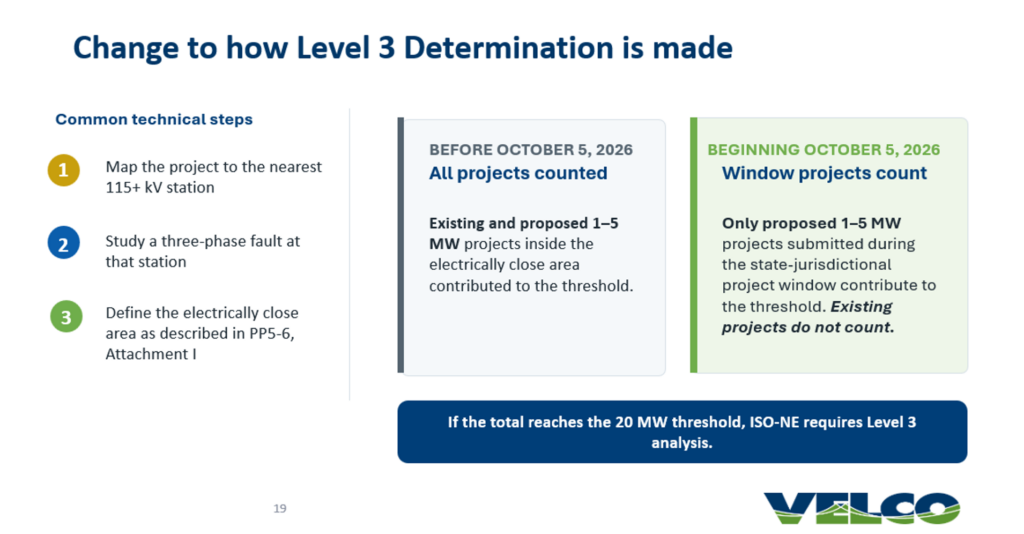
Looman added that the process for determining what constituted an “electrically close area” is complex and not always intuitive, which can add uncertainty. He suggested three action steps for developers, utilities, and planners to minimize the likelihood of Level III studies:
- Submit interconnection request during the submission window
- Look beyond the interconnection point to understand the electrically close area, and
- Coordinate early and often.
Hand emphasized that Level III studies increase the amount of capital that is at risk if an interconnection study fails. Level III studies add cost directly but also mean that other study expenditures must be incurred before the interconnection determination is completed if the developer wishes to maintain the same development timeline as a project with a Level 0 determination. Ultimately, the greater upfront capital risk leads to higher capital cost.